
Onslow County Court Records After Arrest
After an Onslow County jail arrest, the custody record and court record are separate records with different custodians. The Onslow County Detention Center and Sheriff's Office app address the jail side: booking, current custody, mugshots in the app, and jail contact information. The court side is handled by the North Carolina Judicial Branch through the Clerk of Superior Court and the eCourts system after a criminal case is opened or court proceedings begin.
The prosecutor's office matters because filed charges can change from the charge first seen during booking. District Attorney Ernie Lee serves Prosecutorial District 5, which includes Onslow County. The District Attorney represents the State in criminal proceedings, and those court filings create the charge record that can be searched in eCourts or through public terminals. For custody details, use Onslow County jail inmate records. For booking photos, use the Onslow County jail mugshots page.
Find Court Records After an Onslow County Arrest
The main online court channel is the North Carolina eCourts Portal. North Carolina Judicial Branch pages say Portal lets users search case information, hearing dates, records, documents, and payments in eCourts counties, including Onslow County. Public self-service terminals at the clerk's office are another path, especially when older paper files or documents are not easy to find online.
- Confirm the booking through the sheriff app or Booking at 910-937-1470 if custody is still unclear.
- Search the NC eCourts Portal by defendant name, case number, citation, attorney, or hearing-date information.
- Limit results to Onslow County when portal filters are available.
- Open the case record and compare filed charges, status, hearing dates, and public documents.
- Contact the Clerk of Superior Court or use courthouse terminals when the portal does not show the needed record.
North Carolina Judicial Branch guidance says public terminals can search by defendant name, case number, or victim/witness name. It also says paper court files can be accessed at the clerk's office in the county where the case is located, with copies available for a fee.
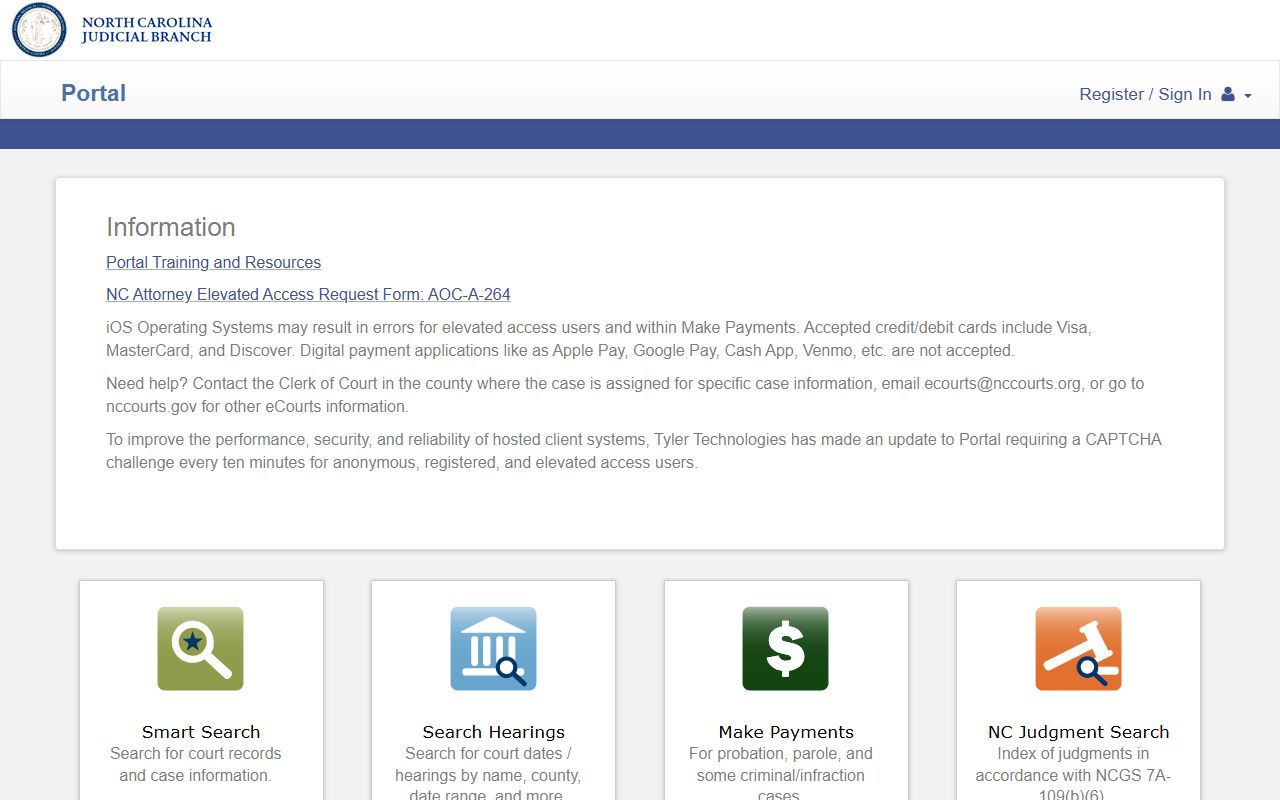
The portal is for case records and court dates. It is not the same as the Sheriff's Office app used for current jail custody.
Onslow County Court Search Fields
The court research captured official descriptions rather than a sample criminal case. Those descriptions still identify the fields a reader should try first. Name searches are useful when the case number is unknown, while case number, citation, and hearing-date searches help narrow common names.
| Field Label | Type | Required | Notes |
|---|---|---|---|
| Name | Text / smart search | Optional or unspecified | Search by party or defendant name. |
| Case Number | Text | Optional or unspecified | Use when known from citation, warrant, clerk notice, or court paperwork. |
| Attorney | Text | Optional or unspecified | NCAOC says Portal supports attorney search. |
| Citation | Text | Optional or unspecified | Useful for traffic and some criminal matters. |
| Hearing date / court date | Date search | Optional | NCAOC says hearing dates can be searched by name, attorney, case number, and more. |
| County | Filter | Likely available | Limit searches to Onslow County when filters are offered. |
Charges Filed After Arrest
An arrest starts the criminal process, but it does not by itself prove the final court charge. A law-enforcement officer or magistrate may begin criminal process, and the prosecutor may later file, amend, reduce, dismiss, or pursue the charge in a different form. Complaint, information, and indictment are common charging-document terms. North Carolina case practice can be more specific by offense and court level, so treat the table as a plain-language map, not legal advice.
| Document | Plain Meaning | Why It Matters |
|---|---|---|
| Complaint | A sworn charging statement or criminal process tied to the alleged offense. | Often appears early in the arrest-to-court path. |
| Information | A prosecutor-filed charging document used in some criminal matters. | Shows the State's filed charge rather than only the booking label. |
| Indictment | A grand-jury charging document for felony prosecution. | May replace or refine the charge listed at booking. |
Onslow County Charge Status
Charge status is the current position of a count in the court case. It can change more than once. A booking charge may later be shown as pending, amended, dismissed, reduced, superseded by indictment, or resolved by plea, verdict, or judgment. A dismissed charge is not a conviction. A pending charge is still an accusation.
| Status | What It Means |
|---|---|
| Pending | The case or charge remains open and has not reached final disposition. |
| Amended or reduced | The filed charge changed from an earlier version. |
| Dismissed | The charge ended without a conviction on that count. |
| Convicted | A plea, verdict, or judgment resulted in guilt on that charge. |
| Failure to appear | A missed court date may create a new order or warrant issue. |
Bond After an Onslow County Arrest
Bond and release questions often sit between the jail and the court. The Onslow County research lists the Magistrate's Office at 910-478-3619 and the courthouse at 910-478-3600. A county bond-scam warning states that official bond payments must be made through the Onslow County Magistrate's Office or a licensed local bail bonding company. It also warns families not to pay callers claiming to be detention staff and demanding informal payment.
| Bond Term | How It Works |
|---|---|
| Written promise | Release based on a promise to appear in court. |
| Unsecured bond | A money amount is set, but payment is not required unless court terms are violated. |
| Secured or cash bond | Money or security must be posted before release. |
| Surety bond | A licensed bail bonding company posts bond under North Carolina bail rules. |
| No-bond hold | The person cannot be released on ordinary bond until a court or agency hold changes. |
Holds and detainers can keep a person in custody after one bond question is answered. Probation, parole, another county warrant, federal custody, immigration process, or a court no-bond order can all change release timing.
Warrants Before Court Records
The research did not locate an official Onslow County public active-warrant search page. A warrant may still be the reason for the arrest, and it can lead to booking at the Onslow County Detention Center. After booking, the jail app may show the custody record, while eCourts or clerk terminals may show the related case record, court date, or failure-to-appear issue if it is public.
For warrant-related court records after arrest, use the Sheriff's Office main number, Magistrate's Office, Clerk of Superior Court, eCourts Portal, or a public-records request as the facts require. If a municipal police agency generated the case, the police report may need to be requested from that agency rather than the Sheriff's Office.
Charges vs Convictions
A charge is an allegation. A conviction is a court outcome after a plea, verdict, or judgment. This distinction is critical for Onslow County court records after a jail arrest because a roster or case search can show charges long before any final outcome exists.
| Question | Charge | Conviction |
|---|---|---|
| Stage | Early or active case stage | Final or resolved stage |
| Meaning | An accusation filed or pursued in court | A court finding or plea of guilt |
| Can change | Yes, it may be amended, reduced, or dismissed | May be appealed, corrected, or later affected by relief |
| Search caution | Do not treat it as proof of guilt | Read the judgment and disposition details |
Sealed vs Expunged Arrest Records
North Carolina law includes expunction paths for some dismissed, not-guilty, and qualifying nonviolent matters. The research identifies N.C.G.S. 15A-145.5 for certain nonviolent misdemeanor and felony convictions and related qualifying conditions. Court relief is handled through legal court processes, not through a jail roster search.
| Record Treatment | Effect | Practical Step |
|---|---|---|
| Sealed or restricted | Public access is limited by law or court order. | Ask the clerk or an attorney how the specific case is treated. |
| Expunged | Qualifying records may be removed from public access under court order. | Use the statutory process and clerk/court forms where eligible. |
| Not eligible or not ordered | The public case record may remain visible. | Verify disposition before relying on a search result. |
Public Access Limits After Arrest
North Carolina public-records law makes many government records available, but it does not open every part of a criminal case or investigation. N.C.G.S. 132-1.4 restricts criminal-investigation and criminal-intelligence records while identifying information that must be released, such as arrested-person information and certain arrest circumstances. Juvenile matters, sealed records, medical information, confidential informants, and some active investigative material may be withheld.
Important: Court, custody, and charge information can change quickly; verify legal decisions with the clerk, court, attorney, or originating agency.
Onslow County Court Contacts
For court records after an arrest, the courthouse and District Attorney contacts are more relevant than the jail once the case is filed. The Onslow County Courthouse is listed by the Judicial Branch at 625 Court Street in Jacksonville. The Clerk of Superior Court main number is 910-478-3600, the District Attorney number is 910-478-3610, and the Magistrate's Office number is 910-478-3619.
The Onslow County Courthouse page publishes courthouse location, hours, and parking information.
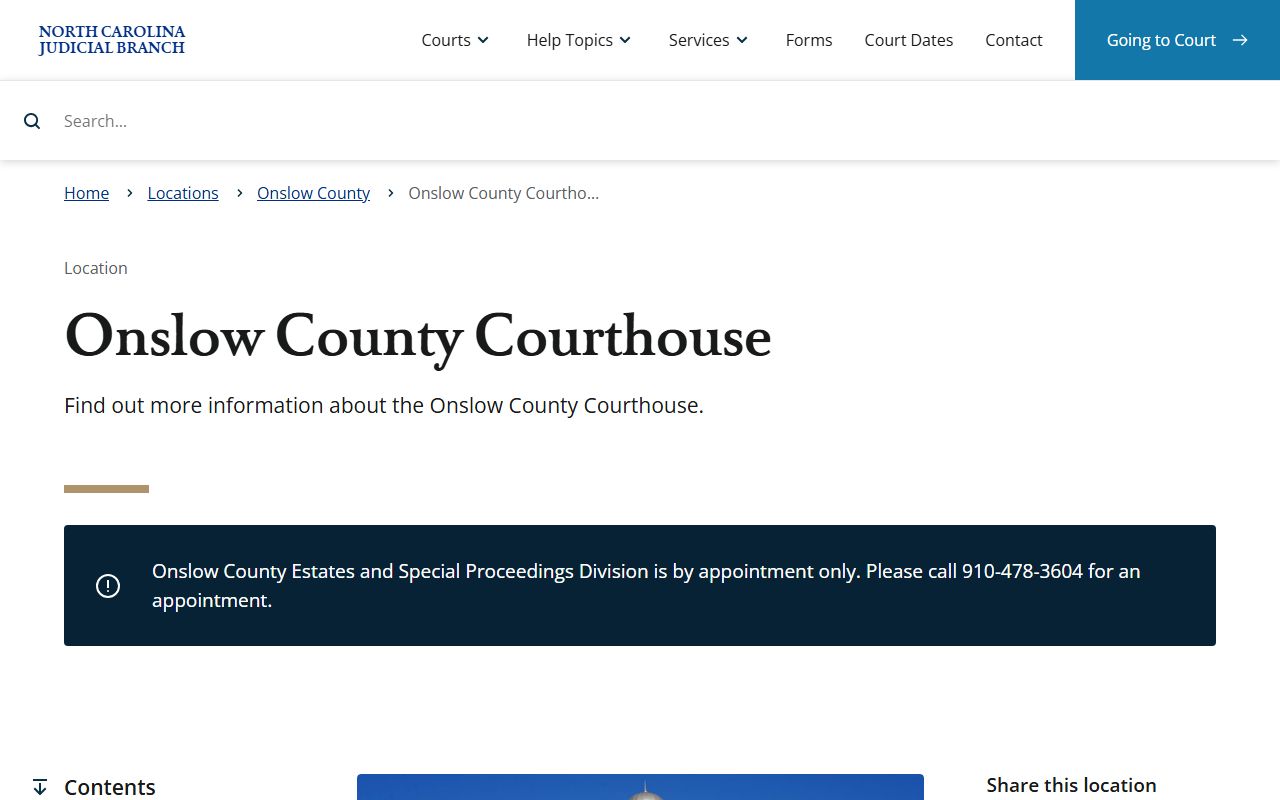
The courthouse source is the right place to confirm public terminal access, clerk services, and in-person record logistics before visiting.
Public Record Search
Sponsored Results